Instruments · Horizontal basses
Ampeg horizontal basses and the AEB-2 / AUB-2
The original scroll basses, the long-scale string problem, the set-up that makes the stock pickup usable, and the re-engineered instruments that Bruce Johnson designed for Ampeg in the late 1990s.
About this page
This address was announced in October 1998 as the place to find “availability, production and technical details of the new AEB/AUB-2 horizontal basses built by Bruce Johnson for Ampeg”. The page itself did not survive in any archive, so it has been rebuilt from the details published on this site at the time and from the surviving information about these instruments.
The original horizontal basses
Ampeg's horizontal basses were introduced in 1966 and have been informally called the “f-hole bass” or the “scroll-head bass”. Four body shapes and two pickup systems were used across the family.
| Model | Body style | Frets | Pickup |
|---|---|---|---|
| AEB-1 | Scroll-head, f-hole | Fretted | Diaphragm transducer |
| AUB-1 | Scroll-head, f-hole | Fretless | Diaphragm transducer |
| ASB-1 | “Devil bass” | Fretted | Diaphragm transducer |
| AUSB-1 | “Devil bass” | Fretless | Diaphragm transducer |
| AMB-1 | Scroll-head, f-hole | Fretted | Magnetic, shorter tailpiece |
| AMUB-1 | Scroll-head, f-hole | Fretless | Magnetic, shorter tailpiece |
| SSB | Short scale | Either | Magnetic |
The AEB-1 and AUB-1 were designed by Dennis Kager. The AUB-1 was one of the earliest — possibly the earliest — fretless electric bass. In the late 1960s the AEB-1 and AUB-1 were refitted with a magnetic pickup and a shorter tailpiece and became the AMB-1 and AMUB-1.
All of the early instruments used a diaphragm transducer rather than a magnetic pickup to reproduce string vibration. The transducer sits under the feet of the bridge and senses the movement of the soundboard in the same way an acoustic instrument's sound is produced. The consequence is that gut or steel strings can be used, and the characteristic sound is a short-sustained thud rather than the sustaining tone of a magnetic pickup.
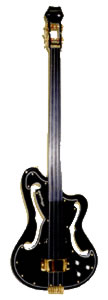
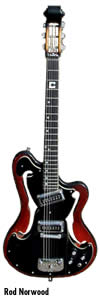
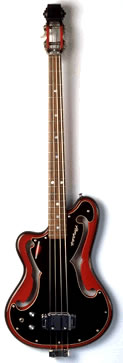
The AEB-2 and AUB-2
In 1998 Ampeg returned to the horizontal bass. Bruce Johnson, proprietor of Johnson's Extremely Strange Musical Instrument Company, had been designing a new series of horizontal basses for Ampeg, and the first prototypes were offered for sale in October of that year. The instruments were produced as the AEB-2 (fretted) and AUB-2 (fretless).
These were not slavish reissues. They kept the body shape, the horizontal playing position and the visual character of the originals while re-engineering the parts that had always caused problems: the neck joint, the bridge and the pickup system. In the words used at the time on this site, they preserved “that cool Ampeg vibe” while being thoroughly modern instruments with flexible sound and excellent playability.
Availability
The production and availability details published here date from 1998 and 1999 and are no longer current. Ampeg has changed hands twice since then, and these instruments are long out of production. For anything to do with the AEB-2, the AUB-2, reproduction parts, or the extra-long-scale strings these basses need, contact Bruce Johnson directly through xstrange.com rather than relying on the historical information below.
Strings: the long-scale problem
Ampeg horizontal basses have an unusually long scale, and ordinary bass strings are simply too short. For years the only source was a single supplier, and when that shop closed there was a genuine risk that these instruments could not be played at all.
Bruce Johnson stocks sets made to the correct length, in both flatwound and roundwound, and has carried several brands. If you are buying strings for one of these basses, measure the scale length of your instrument rather than relying on the model name, because the family is not uniform.
Set-up: getting a usable sound
The single most common complaint about the original horizontal basses is the pickup. It is a diaphragm transducer, and it is sensitive to how the instrument is set up. Four things make a large difference:
- Action and tailpiece. Setting the action and the tailpiece correctly reduces the unwanted nasal and ringing sounds that these basses are known for. This is the first thing to attend to, before spending money on anything else.
- Damp the afterlength. Damping the strings between the bridge and the tailpiece removes a whole family of spurious resonances. Traditional string muting material works well.
- Use the mute properly. These basses have a string mute under the bridge cover, and unlike most makers' versions it is genuinely easy to use. Loosen the thumbscrews that mount through slots and hold the bridge cover to the body, then slide the cover along the axis of the strings. Move it back so the mutes contact only the non-speaking portion of the strings, or slide it part or all of the way onto the strings to vary the degree of muting.
- Equalise deliberately. A parametric equaliser transforms the stock pickup. Boost the mids, sweep the frequency control until the nasal quality is at its unbearable worst, then notch that frequency right out. It takes a few minutes and it works.
Another feature worth knowing about is the tilt adjustment of the neck, much like Fender's Micro-Tilt adjuster, which appeared six years later.
The horizontal bass registry
Because so few of these instruments were made and they differ from one another in detail, owners have long tried to keep track of what survives. Recording a bass properly means noting the model code, the serial number, the body style, whether it is fretted or fretless, the pickup type, the cosmetics and any distinctive features.
The Ampeg Amplifier Survey worksheet was designed for amplifiers, but the principle is the same, and the same discipline applies: record the model exactly, record the serial number, record what the original components say, and do not guess at what you cannot see.
Please tell him we sent you
If you contact Bruce Johnson about a horizontal bass, parts, strings or set-up advice, mention that you came from this site. He has helped more owners of these instruments than anyone else, largely for free, and he deserves the custom.
← All Ampeg instruments · Parts & services · Relevant links
Rebuilt from the 1998 announcement and the instrument references published on this site. Availability information is historical.