Amplifiers · 1957–1972
“Aerospace” amplifiers and other odd little combo amps
Ampeg's small combos carried the names of the space age: Jets, Rockets, Geminis, Echo Twins, Reverberockets and a Mercury. They were built to be carried, they sound like the 1960s, and their circuit codes are a language of their own.
How to read Ampeg's combo model codes
The letters describe the features and the digits describe the speaker, not the power output. G is a guitar amp, J a Jet, R a Rocket or Reverberocket, M a Mercury, E an Echo. An S in the middle indicates a reverb-equipped version, and a V indicates two speakers, so a GV-22 is a two-speaker 2×12" amplifier and a G-15 is a single 15". This is the pattern the model numbers follow, not a published factory rule.
On this page
Echo Jet and Echo Twin
EJ-12, EJ-12-A, EJ-12-D · 1963–1965
EJ-12 Echo Jet
- Single channel, two inputs
- One 12" CTS alnico speaker
- Outboard reverb unit on alligator clips — it attaches to the speaker terminals of a regular amplifier, and also works as a stand-alone amplifier
- Reverb only; no tremolo
- 2×7591A, 1×6D10, 5Y3GT rectifier
- 14½ × 18¾ × 10½ in; 21 lb (one source gives 25 lb)
- List price $129.50 in the early 1960s
Power output is reported as 18 W RMS for the EJ-12-A, but early material describes the EJ-12 as a 12-watt unit. The EJ-12-A replaced the EJ-12 in early 1965; the EJ-12-D was a 1965-only variant.
ET-1, ET-1-B, ET-2, ET-2-B · 1960–1964
ET-1 Echo Twin and ET-2 Super Echo Twin
- 30 W total, wired as two 15 W channels — these were Ampeg's stereo amplifiers
- Two channels, one for guitar and one for accordion, with two inputs each, plus a stereo input jack
- Two 12" speakers, commonly Jensen C12Q
- Reverb and tremolo, with a double footswitch
- ET-2-B: 4×6SL7, 4×7591A, solid-state rectification
- 18½ × 27 × 12½ in; 46 lb
- List price $379.50 in the early 1960s
The Super Echo Twin was introduced in 1962 and the ET-2-B was a 1964-only version. Earlier references list four inputs rather than five; the fifth is the stereo jack.
Gemini I, Gemini II, Gemini VI and Gemini 22
G-12 · 1965–1972
G-12 Gemini I
- 20 W RMS
- Two channels — guitar and accordion — with two inputs each
- One 12" Jensen C12Q speaker
- Reverb, tremolo, Ultra High control and Repeat Percussion
- 2×7591A, 3×12AX7, 1×7199, 1×6CG7, solid-state rectifier
- 22 × 25 × 12½ in; 46 lb
Stayed in the catalogue until 1972, which makes it one of the longest-lived of the space-age combos.
G-15, G-15L · 1965–1968
G-15 Gemini II
- 30 W RMS
- Two channels, four inputs
- One 15" speaker; the “L” version used a JBL D130F
- Reverb, tremolo, Ultra High control and Repeat Percussion
- 2×7868, 3×12AX7, 1×7199, 1×6CG7, solid-state rectifier
- 26 × 25 × 11½ in; 60 lb in the L version
Replaced in the line by the GV-15.
GS-15-R · about 1965–1970
GS-15-R Gemini VI
- Single channel with four inputs — guitar, accordion, auxiliary and microphone
- One 15" speaker
- Reverb, tremolo and vibrato; the reverb control is marked “Echo Dimension”
- 2×7591A, 1×7199, 2×12AX7, 1×6CG7, solid-state rectifier — taken from the surviving factory schematic
The 30 W rating for this model rests on a single source; the two 7591A output tubes are consistent with roughly 25–30 W but no authoritative figure has been found. Cabinet dimensions and weight are unconfirmed.
GV-22 · 1969–1972
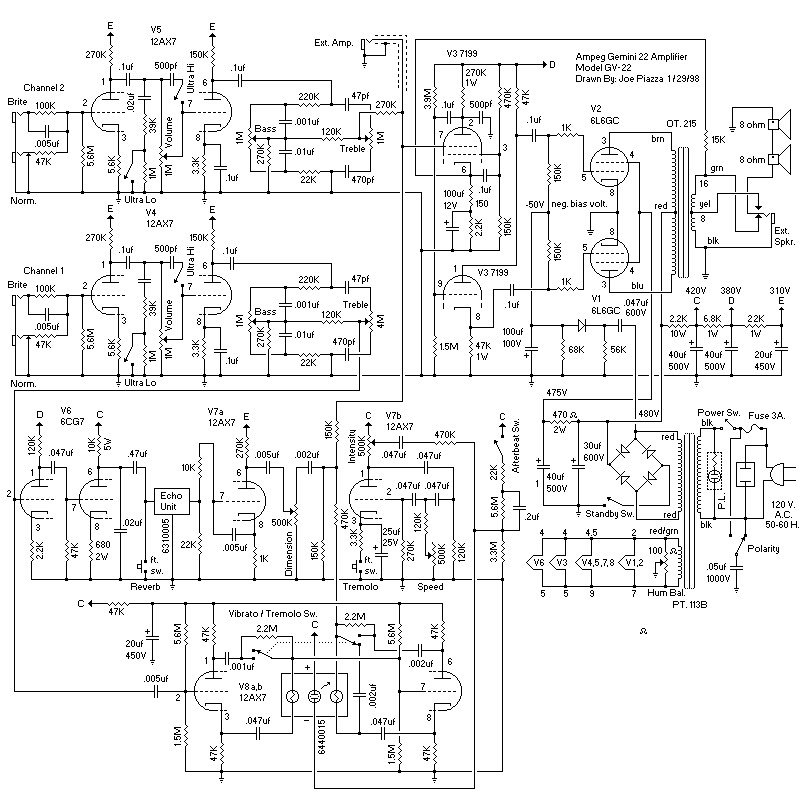
GV-22 Gemini 22
- Two channels — Normal and Bright — with two inputs each
- Two 12" speakers
- Reverb, tremolo, vibrato and Ultra Hi/Lo switching
- Eight valves: 4×12AX7, 1×6CG7, 1×7199 and 2×6L6GC
Power output is disputed in the sources: 35 W is the best-supported figure, 40 W is also quoted, and some listings repeat the “22” from the model name as though it were a wattage, which it is not. A schematic drawn by Joe Piazza is available on the schematics page.
Jet and Reverbojet
J-12, J-12-A, J-12-B, J-12-D · about 1959–1970
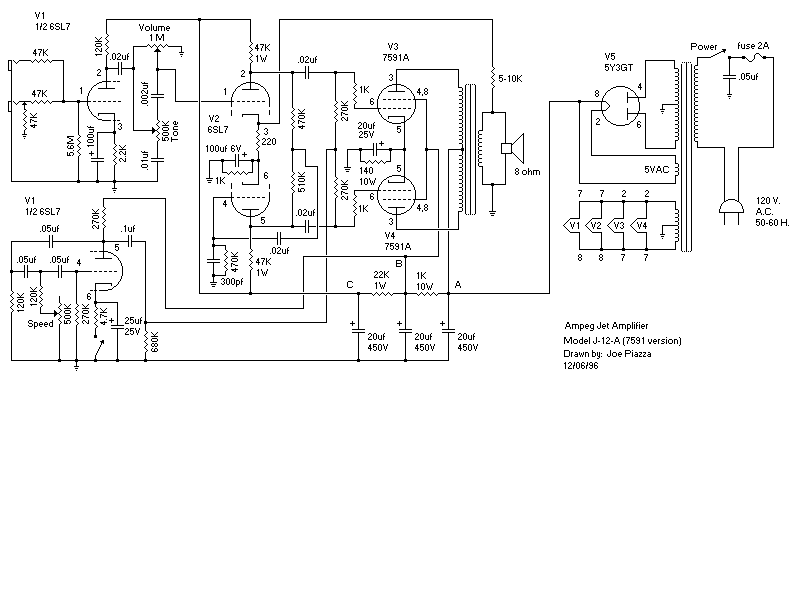
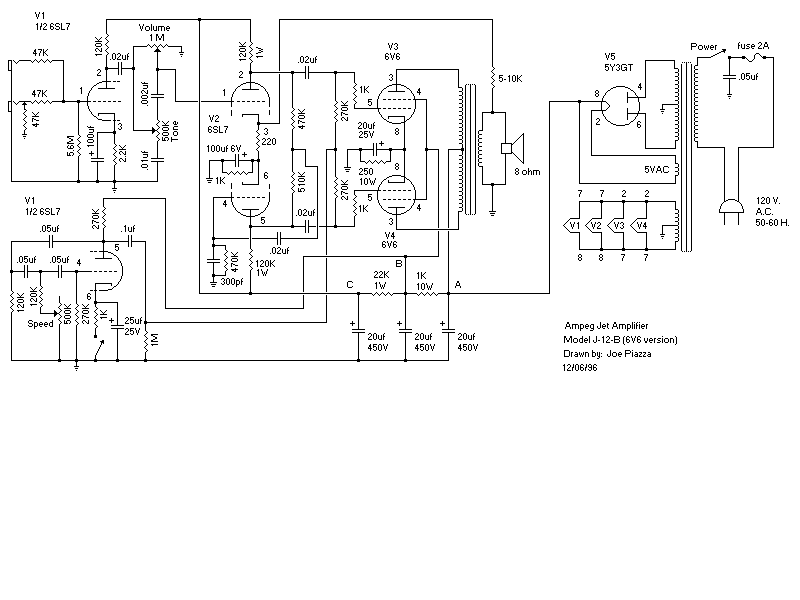
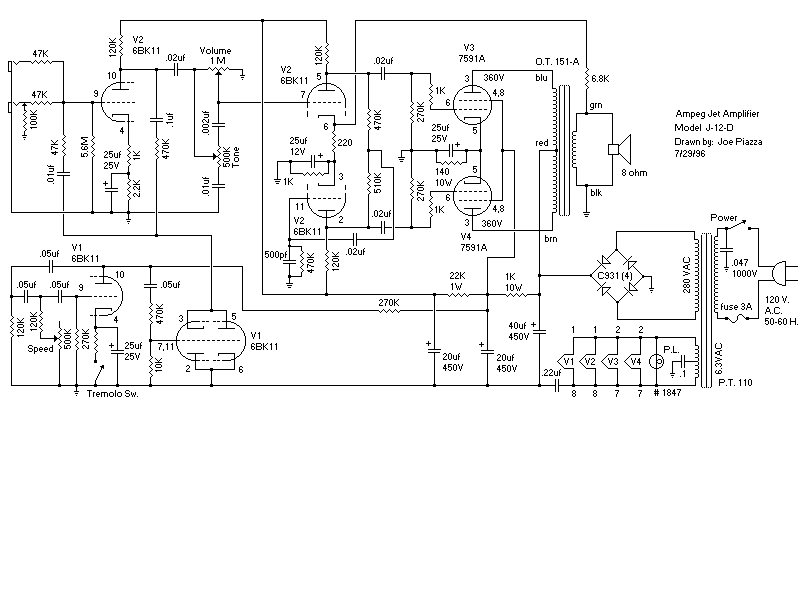
J-12 Jet
- Single channel, two inputs
- One 12" speaker; Jensen P12S in the early versions
- Tremolo, but no reverb
- Early circuit: 2×6V6GT, 2×6SL7, 5Y3GT rectifier
- Later circuit: 2×7591, 2×12AX7, solid-state rectifier
- 14 × 19 × 10 in; 21 lb (1959)
- 12 W RMS in the 6V6 era, 18 W with the 7591s
At least five circuit revisions exist. The second version ran from 1967 to 1970. Schematic diagrams for the J-12-A, J-12-B and J-12-D are on the schematics page.
J-12R · 1968–1971
J-12R Reverbojet
- 18 W RMS
- Single channel with Bright and Normal inputs
- One 12" CTS alnico speaker
- Reverb and tremolo
- 2×7591A, 1×6U10, 2×12AX7, solid-state rectifier
- 19 × 18 × 11½ in; 28 lb
Rocket
R-12, R-12A · about 1960–1965
R-12 / R-12A Rocket
- Single channel with three inputs — guitar, accordion and microphone
- One 12" speaker
- Tremolo; no reverb
- The R-12A used 7591 output valves
This is the least documented model on the page. Confirmed production for the R-12A is 1964–1965, and the R-12 appears to have started around 1960. Power output, the early valve complement and cabinet dimensions are all unconfirmed, so nothing is quoted here rather than guessed at.
Reverberocket and Reverberocket 2
R-12-R, R-12-R-B, R-12-R-T · from 1961
R-12-R Reverberocket
- 15 W RMS
- Single channel with three inputs — guitar, accordion and microphone
- One 12" Jensen C12R speaker
- Reverb and tremolo
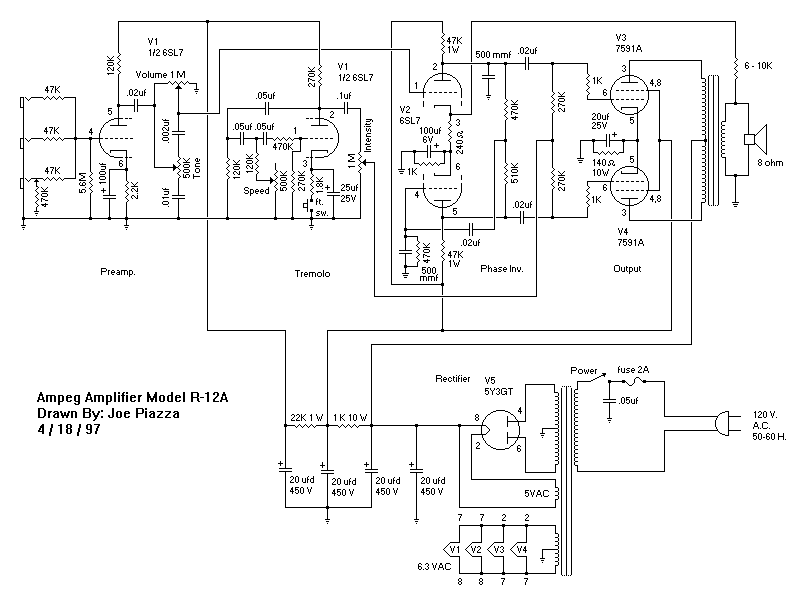
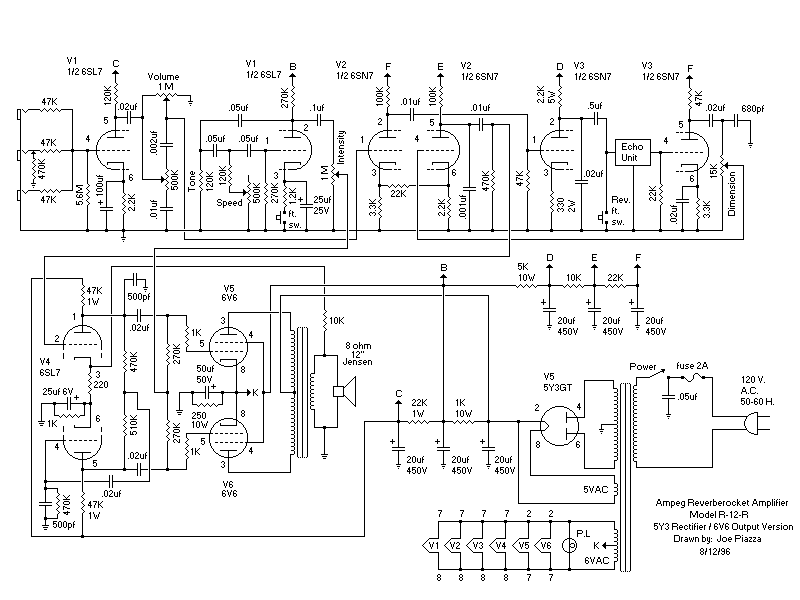
- R-12-R: 2×6V6GT, 2×6SL7, 2×6SN7, 5Y3GT rectifier
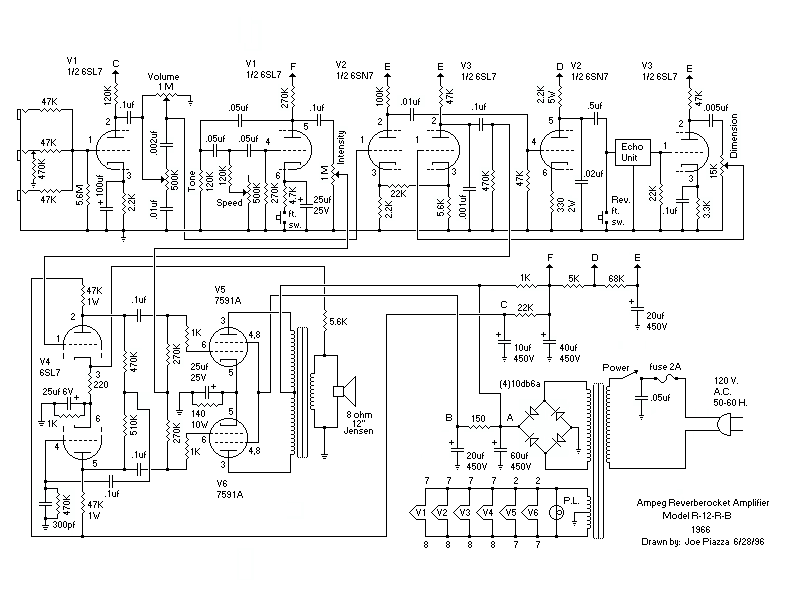
- R-12-R-B (1964): 7591A output valves
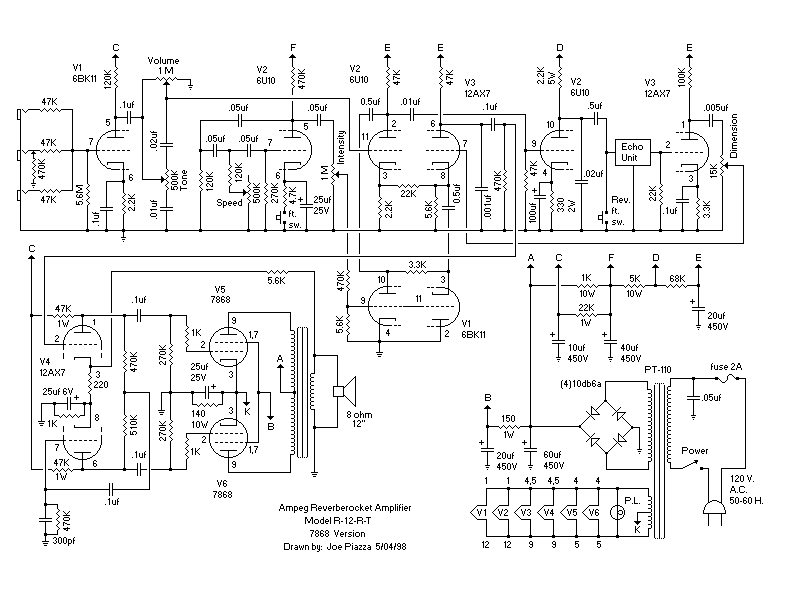
- R-12-R-T (1965): 2×7868, 2×12AX7, 1×6U10, 1×6BK11, solid-state rectifier
- 20¾ × 18½ × 10½ in; 32 lb
Introduced in 1961, making it one of the earliest reverb-equipped guitar amplifiers from any maker. Some listings give 12 W rather than 15 W. Schematics for three versions are on the schematics page: R-12-A, R-12-R, R-12-RT and R-12-RB.
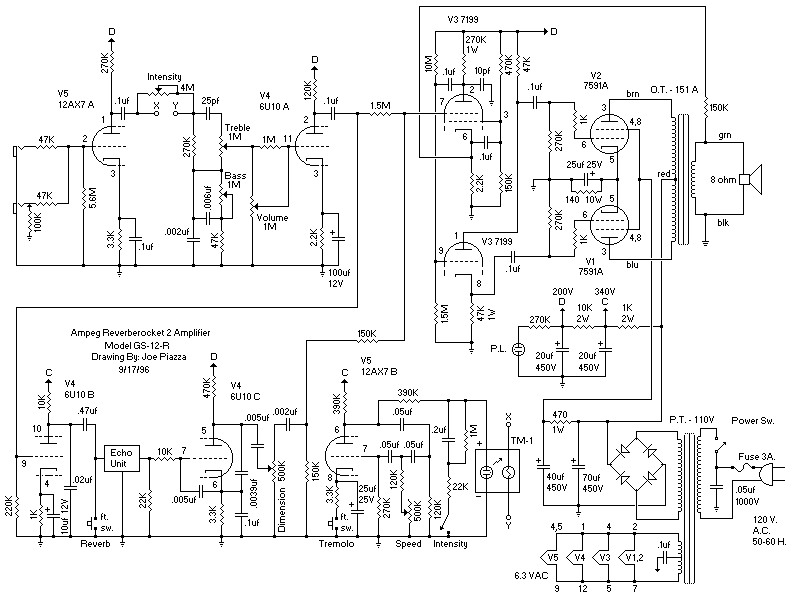
GS-12-R · late 1965–1970
GS-12-R Reverberocket 2
- Two inputs
- One 12" speaker
- Reverb and tremolo
A schematic drawn by Joe Piazza is available. Power output and dimensions are unconfirmed.
Supereverb / Superbreverb
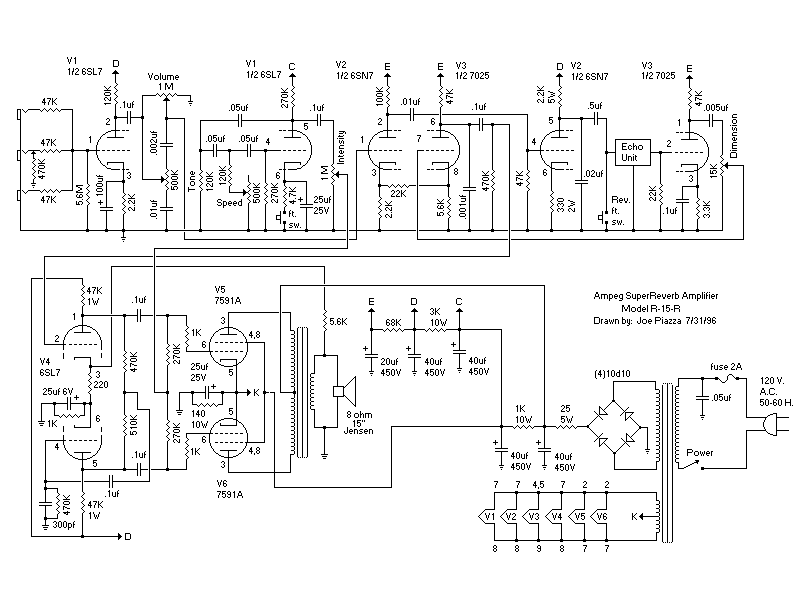
R-15-R · late 1963–1964
R-15-R Supereverb, later Superbreverb
- 25 W
- Single channel with three inputs — guitar, accordion and microphone
- One 15" CTS ceramic speaker
- Reverb, marked “Echo Dimension”, plus tremolo
- 2×7591A, 2×6SL7, 1×6SN7, 1×7025, solid-state rectifier
- 21 × 20½ × 12 in; 40 lb
Sold as the Supereverb from late 1963, then renamed Superbreverb in mid-1964 after an objection from Fender, who already used the Super Reverb name. Same amplifier, two names — worth knowing if you are searching for one. A schematic is available.
Mercury
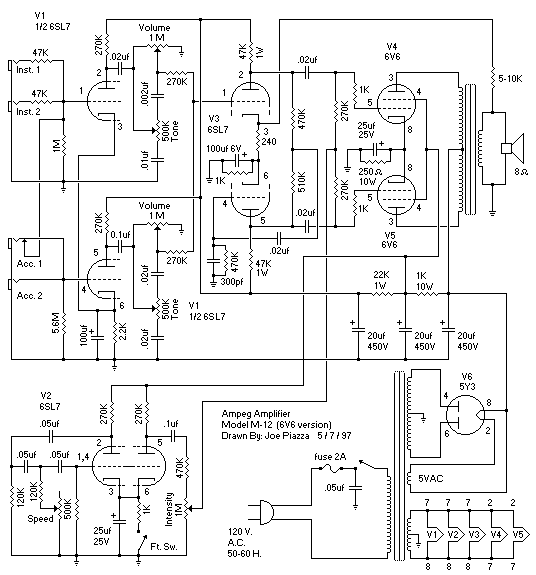
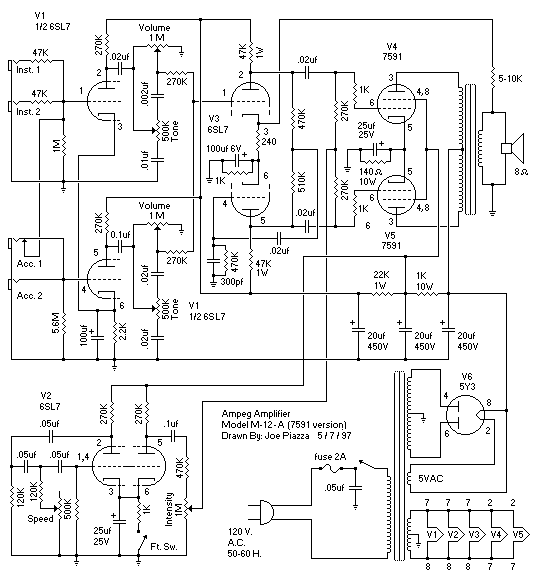
M-12, M-12-A · from 1957
M-12 and M-12-A Mercury
- 18 W RMS in the M-12-A
- M-12: two channels with four inputs, two for instruments and two for accordion
- M-12-A: two instrument inputs, one accordion input and one stereo input
- One 12" CTS alnico speaker
- Tremolo only — the Mercury never had reverb
- M-12-A: 2×7591A, 3×6SL7, 5Y3GT rectifier
- 20¾ × 18½ × 10½ in; 27 lb in the M-12-A
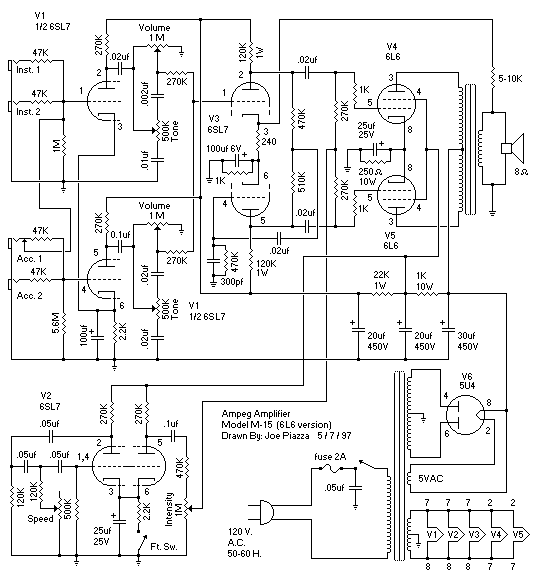
The early M-12 used 6V6 output valves; the 1965 Mercury circuit used 7591As, which is one of the cosmetic-and-circuit checks that lets you separate a 1960 amplifier from a 1965 one. Both versions are documented on the schematics page: M-12, M-12-A and M-15.
Summary table
| Model | Code | Watts | Speaker | Effects | Years |
|---|---|---|---|---|---|
| Echo Jet | EJ-12 | 12–18* | 1×12" | Reverb | 1963–65 |
| Echo Twin | ET-1 / ET-2 | 30 (2×15) | 2×12" | Reverb, tremolo | 1960–64 |
| Gemini I | G-12 | 20 | 1×12" | Reverb, tremolo | 1965–72 |
| Gemini II | G-15 / G-15L | 30 | 1×15" | Reverb, tremolo | 1965–68 |
| Gemini VI | GS-15-R | 25–30* | 1×15" | Reverb, tremolo | c.1965–70 |
| Gemini 22 | GV-22 | 35* | 2×12" | Reverb, tremolo | 1969–72 |
| Jet | J-12 | 12–18 | 1×12" | Tremolo | c.1959–70 |
| Reverbojet | J-12R | 18* | 1×12" | Reverb, tremolo | 1968–71 |
| Rocket | R-12 / R-12A | unconfirmed | 1×12" | Tremolo | c.1960–65 |
| Reverberocket | R-12-R | 15* | 1×12" | Reverb, tremolo | 1961–65 |
| Reverberocket 2 | GS-12-R | unconfirmed | 1×12" | Reverb, tremolo | 1965–70 |
| Supereverb / Superbreverb | R-15-R | 25 | 1×15" | Reverb, tremolo | 1963–64 |
| Mercury | M-12 / M-12-A | 18* | 1×12" | Tremolo | 1957–65 |
Where this information comes from
Ampeg did not publish comprehensive specification sheets for this era, and the surviving sales literature is incomplete. The figures above are drawn from factory schematics that survive, period sales literature, the research published by Greg Gagliano in his Ampeg “FACToids”, and Ampeg: The Story Behind the Sound by Gregg Hopkins and Bill Moore.
Where sources disagree, or where only one source exists, it is marked. We would rather leave a field empty than print a guess: a wrong specification is worse than no specification when somebody is trying to work out whether the amplifier in front of them is original.
Can you fill the gaps?
Photographs of the serial number plate, the valve chart inside the cabinet and the original speaker of any of these amplifiers are genuinely useful. The Ampeg Amplifier Survey worksheet records exactly the details that date an amplifier, and you can generate a report from it without sending anything anywhere.
← Back to the amplifier index · Vintage model directory · Schematics
Page created 25 June 1999; specifications reviewed and expanded. Originally published as a partly finished list under the heading “[to come]”.