Effects & miscellaneous
Ampeg effects and other miscellaneous products
Effectionately yours… Ampeg never made many effects, and the ones it did make were strange, heavy and short-lived. That is precisely why people collect them.
On this page
Scrambler
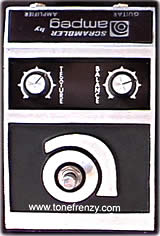
In 1969 Ampeg roared into the effects world with the Scrambler. It was, and still is, distinctively unlike other distortion units of the time, and it does not appeal to everyone. Built like a tank in a heavy cast casing, part of the circuitry was potted in epoxy for copy protection.
The sound of the unit is a mixture of strong fuzz with a bit of octave up and sometimes slight ring modulation. The Texture control ranges from an almost normal-sounding fuzz to one that brings to mind giant mosquitoes on steroids. The Balance control mixes in variable amounts of straight signal. The effect can be very extreme — imagine sound gushing out of a firehose and splattering against the wall.
The Scrambler was not a commercial success for Ampeg, and perhaps 2,500 units were produced, making it one of the more collectible effects.
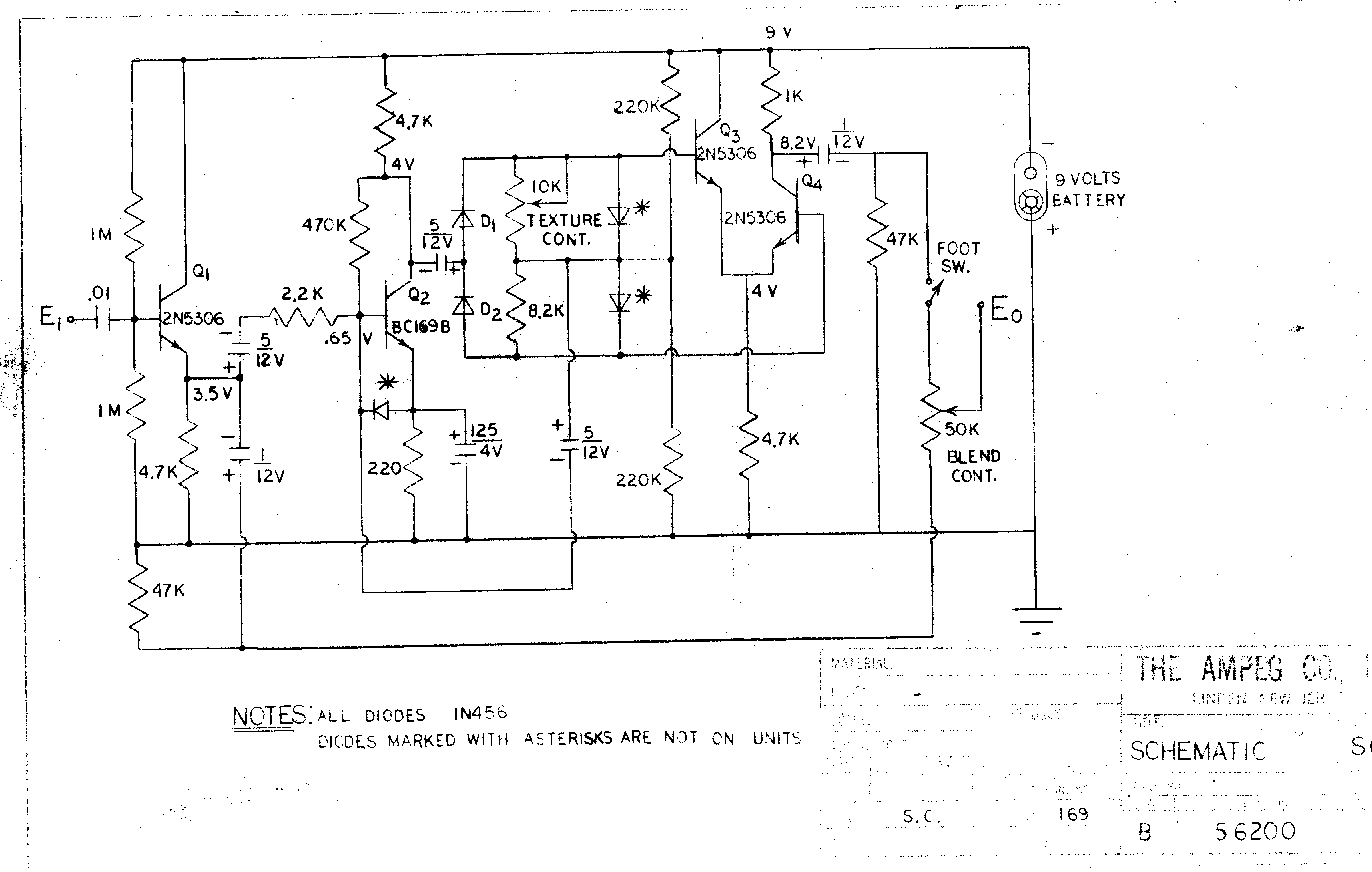
If you are the do-it-yourself type and are inclined to build a copy for yourself, the Scrambler schematic is on the schematics page — free, as everything here is. Note the warning on that page: the battery hookup in the original blueprint is drawn wrong, with the positive and negative leads reversed.
Phazzer
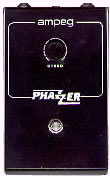
In 1975 Ampeg dared to venture again into the world of guitar effects, this time with a phase shifter called the Phazzer. It is a simple design with a single knob to adjust the speed. There is a trimpot inside to adjust the intensity of the effect, ranging from lacklustre to the point where it sounds as though the guitar is being flogged with a dead fish.
The Phazzer was designed for Ampeg by Time Labs, Inc., and it lasted in production through the late 1970s. The unit pictured should have a silver disk with a black indicator dot on the top of the knob.
The 1980s “A-series” pedals
During MTI's ownership of Ampeg, everything was being built in Japan, and Ampeg's most extensive line of pedals is no exception. In production during 1982 and 1983, the “A” series effects were housed in black steel boxes with brightly coloured graphics in pinks, oranges, blues and yellows, and included nine pedals and a “systems box”.
| Model number | Effect | List price |
|---|---|---|
| A-1 | Distortion | $79.95 |
| A-2 | Compressor | $89.50 |
| A-3 | Over Drive | $89.50 |
| A-4 | Phaser | $99.50 |
| A-5 | Flanger | $139.50 |
| A-6 | Chorus | $132.50 |
| A-7 | Multi-Octaver | $139.50 |
| A-8 | Analog Delay | $199.50 |
| A-9 | Parametric Equalizer | $89.50 |
| SB-5 | Systems Box | $225.00 |
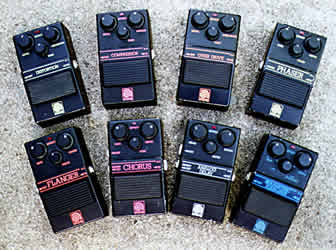
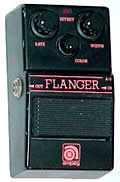
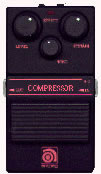
The construction and sound quality of these pedals is equal to other manufacturers' mass production pedals of the time. Unfortunately they are often found without the battery door which, while not quite as easy to lose as the DOD plastic snap-off battery door, can still be easily misplaced and lost.
Time-delay-based effects use the Panasonic MN300X series of bucket brigade delay chips. It is not currently known who manufactured these pedals for Ampeg.
Still looking for a Multi-Octaver.
Sound Cube
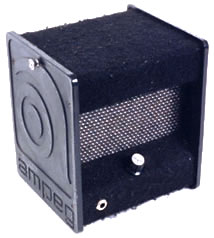
Not an effect but a small practice amp that can be run off a single 9-volt battery or the attached AC power cord, the model 8550 Sound Cube has a surprisingly good sound for a 4" speaker. Each side of the unit is a large black plastic reproduction of the classic Ampeg logoplate. The rest is covered in black Ozite.
There is a single input jack and volume knob on the front, and a preamp-out jack along with the AC cord and its winding pegs on the back. The grille cloth is the typical Ampeg silver/blue material. A strap knob adorns the top of each side, presumably so one could stroll down the street serenading passers-by with the soothing strains of distorted electric guitar.
The Sound Cube was in the Ampeg line from 1975 through 1977. It was not the only practice amp Ampeg made: there was also a Pignose clone called the Buster, in production for only a year, and reference to something called the Peter Portable, about which no information has ever been found and only slight confirmation of its existence.
Hagstrom / Ampeg Patch 2000
The Patch 2000 system probably belongs more properly under instruments than effects. The system was comprised of a Hagstrom Swede guitar or bass modified by wiring the strings and frets to activate the accompanying Patch 2000 synthesiser controller. The instruments also included conventional pickups and could be played in the normal fashion, independent of the controller.
The floor unit included two rocker pedals and a footswitch. The Pitch rocker pedal allowed the player to raise the pitch in semitone increments up to one octave; the Glide pedal controlled the time it takes to move between notes, or portamento; the “5th” footswitch produced a tone seven semitones above the note played. The Patch 2000 controller would in turn be connected to a standard keyboard synthesiser.
The system was a little pricey by 1978 standards:
| Model no. | Description | List price |
|---|---|---|
| 2000 | Patch 2000 Complete — Guitar | $1,495.00 |
| 2001 | Patch 2000 Complete — Bass | $1,495.00 |
| 3520 | Patch 2000 Pedal only | $550.00 |
| 3521 | Pedal case | $80.00 |
| HG2803 | Guitar only, with case | $820.00 |
| HG2903 | Bass only | $820.00 |
| 3522 | 3-wire line cord | $20.00 |
| 3523 | A.C. cord | $6.50 |
| 3524 | Guitar cable | $18.00 |
| 3525 | Printed circuit boards — guitar | $50.00 |
| 3526 | Printed circuit boards — pedal, power section | $25.00 |
| 3527 | Printed circuit boards — pedal, main section | $160.00 |
| 3528 | Neck for guitar | $150.00 |
| 3529 | Neck for bass | $150.00 |
Ampeg instruments · Effect schematics · Vintage model directory
Page created 18 March 2001. Images of the Scrambler and the A-5 Flanger are used with the courtesy of their original sources, as credited.