Reference
Ampeg used six distinct serial number systems between 1949 and the
1990s, and two of them overlap. This guide covers each period, the
years in which serial numbers were duplicated, and the cosmetic
details — control panel graphics, switch types, logo materials
— that date an amplifier when the serial number cannot.
The core of it is reproduced with the kind permission of the authors
of Ampeg: The Story Behind the Sound.
Reference
Almost every original component in an Ampeg carries a code stamped by
its maker: two or three digits identifying the manufacturer, then the
year and the week of production. Learn to read them and you can date an
amplifier built before Ampeg used serial numbers at all.
Portaflex and B-series
The flip-top bass amps: B-12, B-15, B-18, B-25, SB-12, and the
solid-state BT and ST models that followed.
V-series
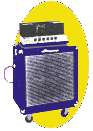
Big, loud, all-tube heads: the V-2, V-3, V-4, V-4B and their more
frightening relatives, the V-7 and V-9. Many ran 7027A output tubes.
SVT
Introduced in 1969 with a separate 8×10 cabinet, the SVT made
everything before it sound like a rehearsal amp. Both the 6146B and
6550A output stages are documented here.
1960s “aerospace” combos
Echo Jet, Echo Twin, Super Echo Twin, Gemini, Jet, Rocket,
Reverberocket, Supereverb and the Mercury.
Solid-state era
From 1971 onward Ampeg increasingly shipped transistor amplifiers.
Dating these is largely a question of cosmetics and features rather
than serial numbers.
Modern Ampeg
From 1986 St. Louis Music built a 10-digit, fully encoded serial
number into every amplifier, covering model, country, year and month.
Before you take the back off
Ampeg amplifiers — especially the high-powered SVT and V-series
models — hold lethal voltages even when they are unplugged and
switched off. Filter capacitors can retain a fatal charge for a long
time. If you are unfamiliar with amplifier electronics or their
operation, do not open the amplifier. Read the
safety guide first.