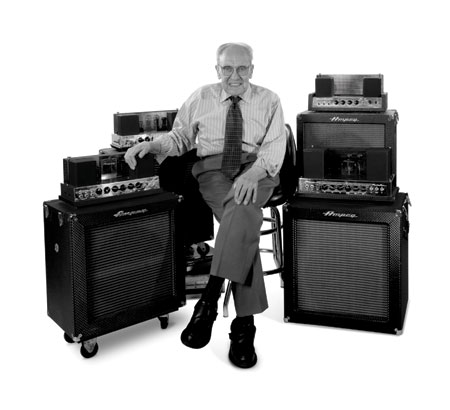
It was with extreme sadness that we learned of the passing of Jess
Oliver. He was a true innovator, and his mark on music will always be
felt, even by those who are not aware of his contributions.
Jess Oliver, who designed the Portaflex, the first guitar combo
with spring reverb, and the Baby Bass pickup.
The man who made the flip-top
Jess Oliver was born Oliver Jespersen in 1926. He played guitar and bass in
high-school bands, was drafted in 1944, and spent his war playing upright
bass in an Army band after pneumonia kept him out of combat. After the war he
studied electronics on the G.I. Bill, worked as an electrician, and gigged
professionally around Queens.
He came to Ampeg in about 1955 as a customer. He had gone to the company's
cramped workshop on 42nd Street in Manhattan to buy an “amplified
peg” for his own bass, and instead ended up working there, joining full
time in 1956. Ampeg paid for his night classes at the RCA Institute. When the
company incorporated in 1959, he became its Vice President — a
remarkable position for a man who had arrived four years earlier to buy a
pickup.
He resigned in September 1966, after that year's NAMM show, as the company's
rapid growth and its manufacturing problems put him increasingly at odds with
its founder.
What he invented
The Portaflex, 1960
The B-15 and its siblings were his. The flip-top function, the
closed-back reflex cabinet and the double-baffle porting were all his
designs, and the patent was filed in his name — although, as was
normal at the time, the patent was held by the company rather than by
him. The B-15 was the first of the Portaflex series, and by 1963 those
amplifiers accounted for 44% of Ampeg's amplifier sales.
Spring reverb in a guitar combo, 1961
The Reverberocket put spring reverb into a guitar amplifier before
anybody else did. It is one of the most widely copied ideas in the
history of the instrument.
The Baby Bass
He re-engineered the Zorko design that Ampeg bought from the Dopera
brothers, and he designed the pickup that gave the instrument its voice.
The year it was introduced is disputed — sources say 1962, some say
1966 — but his involvement in it is not.
The vibraphone pickup
His fourth patent. It was later licensed to Ludwig and Musser, and it
is why a generation of vibraphones sounded the way they did.
After Ampeg
He founded the Oliver Sound Company in late 1966 with Harry Bloom, working
first in Brooklyn, then in Linden, New Jersey, then in Westbury on Long
Island, and finally on his own in West Babylon. Oliver amplifiers — the
Powerflex line in particular, with its motorised lift platform — were
good products that arrived in a market Ampeg and Fender already owned, and
the company never found its footing.
By the mid-1970s he was running a repair and service shop from his basement
in Massapequa Park, New York, and he kept it going into 2009. He also
marketed Karlson “Sound Projector” PA cabinets.
He was never bitter about Ampeg, and Ampeg never forgot him. He acted as a
technical adviser on the 1997 and 2010 B-15 reissues, and in 2001 the company
named him the Godfather of Bass Amplification.
If it were not for the work of Jess Oliver, electric bass as we know it
might not exist.
It is an easy claim to dismiss as an obituary's kindness, and it is not an
exaggeration. The same tributes compare the B-15 to Les Paul's solidbody and
Leo Fender's Precision Bass as one of the handful of inventions that created
the modern musical world. A bassist who has never heard his name has still
played through amplifiers built to his design, because the flip-top cabinet
became the template for how a working bass player's rig is put together.
His amplifiers
Oliver Sound amplifiers are collected in their own right, and they are
scarcer than Ampegs of the same era. If you own one, or you have
documentation or advertising for the Powerflex line,
we would like to hear from you.