Instruments
Ampeg instruments
Ampeg was founded by an upright bassist, and although the company is remembered for its amplifiers, it built and commissioned some of the most distinctive instruments in American music: the Baby Bass, the horizontal scroll basses, the lucite Dan Armstrong See-Throughs and a series of Japanese-built guitars it would probably rather forget.
On this page
Baby Bass
“Years of Ampeg research produced the first all-electric bass with an authentic wood bass sound. If you appreciate bass frequencies you owe yourself the treat of trying our Baby Bass. Smaller than a cello, with adjustable fingerboard, standard length neck and strings, bass nevertheless fits in trunk of compact car.”
Ampeg sales literature
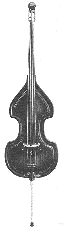
Besides making amplifiers, Ampeg both manufactured and had manufactured for them basses and guitars. Since Ampeg was founded by an upright bassist and the focus of their amplifier manufacture was the lower end of the sound spectrum, it only made sense that their first instrument would be an electric upright bass. It was usually called the Ampeg Baby Bass, although in typical Ampeg fashion the official designation was the BB-4 for the four-string or BB-5 for the five-string version.
List price was $349.50, rising to $475 by the time production ended in the early 1970s. The five-string Baby Bass was $100 more.
The original design was licensed from Zorko and redesigned by Oliver Jesperson. The body, slightly smaller than that of a cello, was formed of Uvex, a plastic manufactured by Eastman Kodak, and filled with a dense foam. The neck was full size, crafted of maple with an ebony fingerboard, and the string action could be adjusted easily by tilting the neck using an Allen screw in the back of the instrument.
The bass was available in mahogany wood grain, white, turquoise, red and black, according to the sales literature of the time. The pickup was a diaphragm transducer positioned directly below the feet of the bridge. In theory this was supposed to translate the vibration of the strings into electrical energy in the same way that string vibration is translated into sound energy in an acoustic upright bass. In practice the typical Baby Bass sound is a short-sustained thud.
Because the original pickup does not rely on magnetic properties, either gut or steel strings could be used. For the current Baby Bass owner there are ways to improve the sound of the instrument without making irreversible modifications, including building a replacement piezo pickup.
Optional accessories included a rib extender to help simulate the upper profile of an acoustic bass, a non-swivelling endpin to prevent twisting while playing arco, a stand and a padded gig bag.
Ampeg-branded Burns instruments
“Professionals to a man agree that these finely-crafted guitars have the fastest, smoothest, easiest-playing necks of any comparable instruments in the world. We offer four outstanding models — truly professional instruments — ‘designed by the professional for the professional.’”
Ampeg sales literature
In the early to mid-1960s, four Ampeg-branded guitars by Burns of London were offered in the sales literature.
- Sonic Six (model EGSS). Solid mahogany body with two tri-sonic pickups, volume and tone controls, rhythm/solo selector and vibrato. Cherry polyester finish. $269.00. Equivalent to the Burns Nu-Sonic guitar.
- Wild Dog Guitar (model EG1.S). Solidbody short-scale, three pickups, four-position selector with Split, Jazz, Treble and Wild Dog settings — “a snarling, twangy combination of tone partials, made possible by unique circuitry in the pickup; ideal for western or rhythm and blues”. Geared truss rod, microbridge suspended on ball bearing rollers, vibrato. Polyester cherry sunburst finish. $399.50, hard case $45.00. Equivalent to the Burns Jazz Split Sound guitar.
- Deluxe Wild Dog Guitar (model EG.3). As above except for a standard length neck, purfled neck binding and a slightly different body contour. $450.00, hard case $45.00.
- Thin Line Guitar (model EGT-1). “Our EGT-1 was designed to meet the demanding requirements of professionals who enjoy conventional styling in a solid model. Top and back are arched and stressed to kill extraneous resonances. Response is enlivened by the ‘power assisted’ transistorised pre-amp operated by one tiny battery inside the pick guard control unit.” Geared truss rod, purfled body and neck. Polyester cherry sunburst finish. $599.00.
Also available, at least for 1963, was the Vista Sonic Bass, based on the Burns model of the same name and analogous to the Wild Dog guitar, with three pickups, a mute and tone switch settings for Contrabass, Bass, Treble and Wild Dog. It is a very full, strong, deep-sounding instrument and, unusually for a bass, it has three pickups. Bass sales must have been low, as these instruments are rarely seen.
Features worth knowing about
- Split Sonic pickups. Each pickup is in halves, with each half wired separately; in effect there were two pickups in each unit. The “Split Sound” setting is actually the bass half of the neck pickup with the treble half of the bridge pickup. There are at least nineteen possible pickup configurations without using odd numbers of coils, so it is a little unfortunate that only four tone switch settings were provided.
- Geared truss rod. Behind the neckplate is access to a shaft that turns the gearbox truss rod adjustment. A special wrench was provided for the purpose.
- Floating bridge. On the Wild Dog models the bridge saddles rest on a solid aluminium block that in turn rests on bearings. When the vibrato arm is actuated, the entire bridge block moves. There is no movement of the strings across the bridge saddles, which helps the guitar to return to tune.
The available hard case for these instruments was covered with the same blue-check tolex as Ampeg's amplifiers.
Many people have the impression that Burns instruments were cheap Fender knock-offs. Nothing could be further from the truth. Jim Burns has sometimes been described as the “English Leo Fender” — an appellation that does a disservice to both men's contributions — and he built quality instruments with innovative features not found elsewhere. Burns-made Ampegs were not popular instruments, probably because the cost of importing them made them much more expensive than comparable American-made instruments such as Fenders.
Ampeg's association with Burns ended in 1965, when Ampeg's competitor Baldwin — having lost out to CBS in its attempt to acquire Fender — purchased Burns instead. For more information on Burns instruments, the relevant links page lists the surviving Burns resources.
Horizontal basses
“These instruments have the rich tonal quality of the acoustic bass … plus tonal adjustment features ranging from a deep mellow bass to a piercing treble … thus providing all the requirements of the professional artist. The secret is Ampeg's technique of authentic sound-wave reproduction and ‘mystery’ pickup.”
Ampeg sales literature
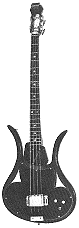
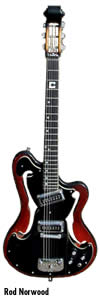
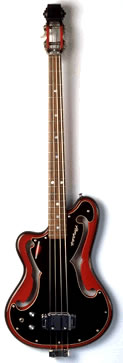
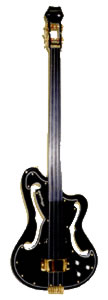
The first Ampeg horizontal basses were the fretted AEB-1 and the fretless AUB-1, designed by Dennis Kager. The AUB-1 was one of the earliest, if not the earliest, fretless electric bass. These distinctive instruments have been informally called the “f-hole bass” or the “scroll-head bass”.
Soon after the AEB's 1966 debut, the “devil bass” in both fretted ASB-1 and fretless AUSB-1 versions emerged from the Linden, New Jersey plant. It was essentially the same bass as the AEB/AUB but with a different body style. All of these basses used a diaphragm transducer rather than the now-standard magnetic pickup to reproduce the string vibrations.
Like many basses made in the 1960s, these instruments provided a string mute underneath the bridge cover. Unlike many other makers' instruments, however, this mute is very easy to bring in and out of play. By loosening the thumbscrews that mount through slots and hold the bridge cover to the body, the bridge cover can be slid along the axis of the strings. The mute can be shut off by moving the bridge cover back so that the mutes contact only the non-speaking portion of the strings, or it can be slid part or all the way onto the strings, varying the degree of muting. Another feature was the tilt adjustment of the neck, much like Fender's Micro-Tilt adjuster, which would appear six years later.
There was at least one left-handed AEB-1 produced. Accessories included a padded gig bag and a case.
There were apparently at least a couple of prototype “f-hole”-style electric guitars built as well, including one with seven-polepiece pickups, perhaps to allow the strings to vibrate between the polepieces. Gruhn and Carter's Electric Guitars and Basses also includes a photograph of a prototype built in the late 1960s.
In the late 1960s the AEB-1 and AUB-1 were refitted with a magnetic pickup and a shorter tailpiece, becoming the AMB-1 and the AMUB-1.
Also available in the mid-1960s was the SSB, a short scale electric bass, either fretted or fretless, with a magnetic pickup. It came in apple red, black or gold sunburst.
Living with a horizontal bass
A modern builder reengineered these instruments and documented them thoroughly. The horizontal basses page covers the AEB-2 and AUB-2, the extra-long-scale strings these basses require and the set-up advice that makes the original pickup usable.
A parametric equaliser helps a great deal with the stock pickup: boost the mids, sweep the frequency control until the nasal quality is at its unbearable worst, then notch that frequency right out. Adjusting the action and the tailpiece properly reduces the unwanted nasal and ringing sounds, as does damping the strings between the bridge and the tailpiece.
Dan Armstrong–Ampeg “See-Through”

In 1968 Ampeg's new owners began a relationship with Dan Armstrong, contracting him to develop and produce the well-known lucite basses and guitars bearing his name. The instruments, listing at $330, debuted at the 1969 NAMM show and were produced until 1971, when Armstrong severed his relationship with Ampeg.
The guitar version featured a 24-fret neck and slide-in pickup modules, enabling the player to choose any of the six available pickups and thereby alter the sound of the instrument. Pickups were originally designed in conjunction with Bill Lawrence and then by Armstrong alone. The guitar came standard with two pickups. The innovative tone circuitry used a three-way toggle to switch between full volume independent of control settings, the tone and volume as set by the controls, and full bass.
The bass, also with a 24-fret neck, was wired differently. There were no slide-in pickups. What appears to be a single pickup is actually two stacked single-coil pickups encased in potting compound. The tone control fades between the larger bottom pickup through a capacitor at one end of the adjustment, to the top treble coil at the other end of its range, with a mix of the two in intermediate positions. Later versions included a switch to bypass the treble coil and introduce another capacitor, resulting in a lower bass tone.
Both the bass and guitar featured maple necks with rosewood fingerboards. Of the thousands of instruments produced, eight guitars and eight basses were made with black plastic bodies, and 150 fretless See-Through basses were made. Rumor has it that a few were produced in red and blue plastic. Can anyone positively confirm this?
A Dan Armstrong information PDF is available on the schematics page. It includes the owner's manual and schematics, including the March 1971 information on updating older Armstrong instruments to the newer circuit.
The Studs
Strictly Heavy.
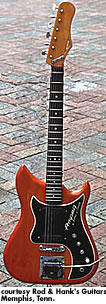
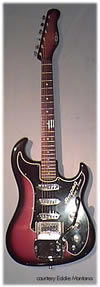
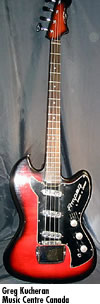
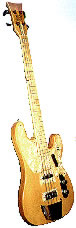
These guitars and basses were made in Japan. In the words of one owner whose Big Stud bass is pictured, “what could they have been thinking? . . . a horrible bass”. The owner was kind enough to provide a picture of this beast in colour so you can see, as he describes it, the “dog piss on plywood” finish. The nadir of Ampeg instruments.
There was also a Little Stud bass in the series, as well as a few six-string guitar models called the Stud, the Super Stud — both shaped somewhat like a Gibson SG — and the Heavy Stud, shaped like a Fender Telecaster.
It has been reported erroneously that the Stud series was manufactured by Hagstrom. Karl Erik Hagstrom says they had nothing to do with them. Reportedly they were manufactured in Japan by Tokai. The neckplate of the Little Stud pictured is clearly marked “Made in Japan”, as are the tuners. The back of the pickup is marked “Maxon”, which reportedly supplied electronics to Ibanez and other Japanese instrument manufacturers. If you know more about these instruments, please pass the information along.
Having owned one and played a friend's Big Stud, the author softened his tone on these instruments. They are really not that bad and have a nice, usable tone. The quality of manufacturing may not be exemplary — the control cavity of one looked like it was routed with a large screwdriver — but many would rather play one of these than other inexpensive basses of the period.
The Little Stud is not short scale; the name more likely refers to the cheaper single-pickup model as opposed to the more deluxe, two-pickup Big Stud.
A few more notes are in order. The bodies are dense plywood. The neck of the Little Stud is also plywood and feels chunky but stable; the neck of the Big Stud played by the author was not plywood. The necks are bound, as are the headstocks. Comparing these instruments to the Sigma line that Martin imported shortly before Ampeg imported these, the similarities are striking, the major difference seeming to be a modified headstock shape. Might they have come from the same factory?
Miscellaneous distributions under Selmer
When Selmer acquired Ampeg, they began to distribute other brands of musical merchandise through Ampeg dealers. Some of these included:
- Hagstrom guitars and basses, including the Patch 2000 guitar and bass synthesiser
- Harmony guitars
- Olympic Drums
- Lyricon wind controller
Modern “reissues”
In later years Ampeg re-entered the musical instrument business with updated versions of both the Baby Bass and the Dan Armstrong See-Throughs, as well as introducing guitars and basses that mimic the Dan Armstrong shape but are instead made of attractively grained and finished wooden bodies. For information on current Ampeg instruments, the manufacturer's own website is the place to look; it is linked from the relevant links page.
Baby Bass pickup project · Horizontal basses · Effects & miscellaneous
Page created 17 November 1995; last modified 23 February 2002. Reorganised into sections with figures.